Why this blog
My name is Arduino Mancini and this is my blog; it stems from the experience I gained over many years of working in organisations, initially as a manager and later as a Business & Executive Coach.
A blog that helps you work within complexity, not simplify it.
This is not a place for theories or easy solutions: you won’t find a collection of “how-to” guides.
My aim is not to offer you ready-made answers, but to present perspectives that will help you rethink what you might take for granted.
The articles are based on real-world experience, gained through working in complex organisational contexts, dealing with real-life decisions and supporting individual and team development journeys.
What you’ll find here
The contents I offer you do not simplify reality, but help you read it so that you can deal with it:
- food for thought on tackling difficult situations and decisions;
- insights into organisational dynamics and ideas for managing complexity;
- common mistakes in managerial and professional contexts, and ways to address them;
- practical approaches to leadership development and personal growth.
The blog is aimed at both those who lead people and those who wish to grow in their roles and build a solid professional foundation over time, addressing change and complexity.
Tools for your development
Alongside the articles, the blog provides practical tools for your work — coaching, training, books, films and eLearning courses — which are used as effective drivers, not merely as supplementary contents.
To stay in touch
If these topics are part of your work, you can explore them further with tibimail, my newsletter.
Subscribe to tibimail.
Read from you soon!
Here are six bad habits that will help you find out!
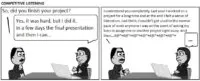
I think we can share the idea that listening is an essential function of communication that multimedia has substantially damaged, because we are systematically urged to devote attention to more than one thing at the same time. Is this all the smartphone’s fault? Absolutely not, because long-standing habits affect listening skills perhaps more profoundly than […]
How the sense of powerlessness can be learned. And taught!
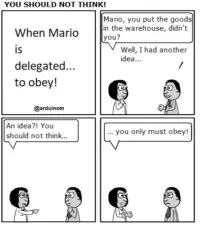
In the cartoon strip, I have reported a conversation that everyone has experienced at least once: which I hope has provoked in you at least a motion of rebellion. Where do expressions such as “You don’t have to think, you just have to obey” come from? What is its purpose? Can one learn pessimism? And […]
An enlightening video will help us answer this question!
Recently a colleague, who works primarily for companies in perpetual search of talent, was puzzled by the content of this video and asked me what I thought about it. After watching it carefully, I realized that Simon Sinek, the author, had in two minutes challenged many of his beliefs about recruitment: beliefs that with my […]
What would you do if your boss reprimands you for not stopping him/her from blundering?
It happens fairly often that the boss asks the staff member to execute his instructions without much discussion. But it can also happen that the boss might reprimand the staff member for not stopping him/her from doing something stupid, as it happens in the cartoon strip. Have you ever experienced anything like this? How did […]
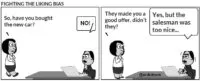
Three questions to defeat your liking bias!
How often it happened to you to buy things that you did not need? Or to buy from one person rather than another without the quality of what you were about to buy playing a crucial role? Much more than you imagine, I bet. In this post, I want to focus on a mechanism that […]
… and a video that will inspire you!
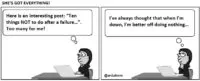
Many people ask me how to react to a failure, that is when the slap they received was loud and left them there in confusion. Well, it is difficult to answer, because the situations can be quite different. I find it more convenient, and useful, to suggest some behaviours to avoid, those that might prevent […]
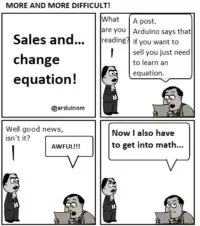
Just the time needed to learn the change equation!
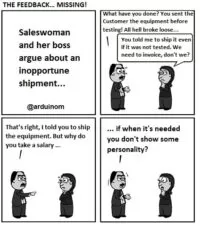
The way sales professionals handle Customer communication is not quite different between one company and another. Too often the focus lands on aspects related to the influence of the salesperson toward the buyer; the salesperson is treated as one of those toys you give the charge to so that he/she will repetitively do the same […]